

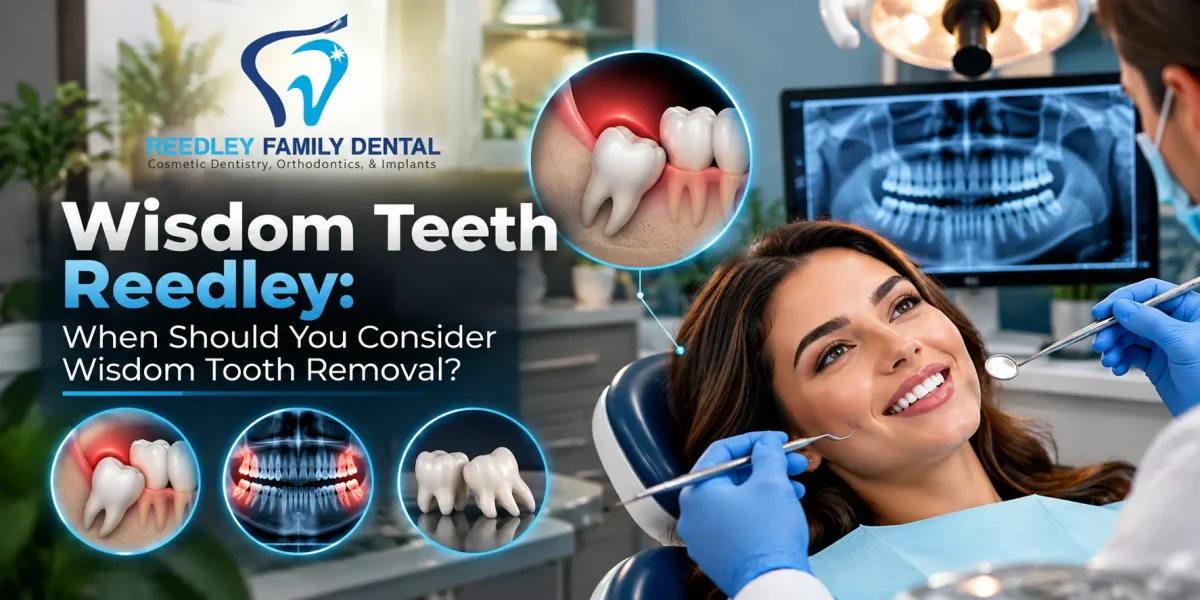
Wisdom Teeth Reedley: When Should You Consider Wisdom Tooth Removal?
Wisdom teeth are the last permanent teeth to develop and typically appear in the back of the mouth during the late teenage years or early adulthood. For some people, wisdom teeth grow normally and never cause significant problems. For others, these teeth can become impacted, difficult to clean, painful, or associated with infection and damage to nearby teeth.
If you are searching for wisdom teeth Reedley, you may be wondering whether your wisdom teeth need to be removed, what happens during the procedure, and how you can recover comfortably afterward.
At Reedley Family Dental, wisdom teeth can be evaluated to determine whether monitoring, treatment, or extraction may be appropriate. The practice’s wisdom teeth information explains that removal may be recommended when a wisdom tooth is causing an existing problem or when its position creates a significant risk of future complications.
This guide explains what you should know about wisdom teeth in Reedley, including common symptoms, impacted wisdom teeth, extraction, recovery, and when you should schedule a dental evaluation.
What Are Wisdom Teeth?
Wisdom teeth are the third molars located at the very back of the mouth. Most people have up to four wisdom teeth—two on the upper jaw and two on the lower jaw.
Unlike many other permanent teeth, wisdom teeth often develop later. By the time they begin to erupt, the jaw may not have enough room to accommodate them properly.
When sufficient space exists and the teeth develop in a healthy position, wisdom teeth may not cause problems. However, when there is inadequate space, a tooth may become partially erupted, tilted, trapped beneath the gum, or impacted against another tooth.
This is one of the main reasons wisdom teeth are frequently evaluated during the late teenage years and early adulthood.
Why Do Wisdom Teeth Cause Problems?
The position of wisdom teeth can make them particularly difficult to clean.
Because they are located so far toward the back of the mouth, toothbrushes and floss may not reach all surfaces effectively. If a wisdom tooth is only partially erupted, a flap of gum tissue can sometimes develop around it.
Food particles and bacteria may become trapped beneath this tissue.
According to Reedley Family Dental’s wisdom teeth information, this can result in red, swollen, and painful gums and may contribute to infection. Impacted wisdom teeth can also potentially affect neighboring teeth, surrounding bone, or contribute to cyst formation.
For these reasons, a wisdom tooth examination is not simply about determining whether the tooth currently hurts. Your dentist also considers its position, development, ability to erupt properly, and potential impact on surrounding structures.
What Does “Impacted Wisdom Tooth” Mean?
A wisdom tooth is considered impacted when it cannot properly erupt into its normal position.
Impaction can occur in several ways.
Vertical Impaction
The tooth is positioned relatively upright but does not have enough room to fully erupt.
Angled Impaction
The wisdom tooth may tilt toward the adjacent molar. This can create pressure and make the tooth difficult to clean.
Horizontal Impaction
The tooth may develop almost sideways beneath the gum or against the neighboring tooth.
Partial Eruption
Part of the tooth becomes visible while another portion remains covered by gum tissue.
Partial eruption can be particularly challenging because bacteria and food can collect around the exposed area.
Not every impacted wisdom tooth automatically requires immediate removal. The appropriate recommendation depends on the individual tooth, symptoms, surrounding structures, and overall oral health.
Signs You May Have a Wisdom Tooth Problem
Wisdom teeth do not always cause obvious symptoms. In some cases, a problem may be discovered during a routine dental examination or imaging.
However, several symptoms may indicate that you should have your wisdom teeth evaluated.
1. Pain at the Back of the Mouth
Pain behind the second molars can be one of the first signs that a wisdom tooth is erupting or causing pressure.
The discomfort may come and go or become more persistent over time.
2. Swollen or Tender Gums
Inflammation around a partially erupted wisdom tooth can cause tenderness and swelling.
3. Difficulty Opening Your Mouth
Inflammation around the back molars can sometimes make opening the mouth uncomfortable.
4. Bad Breath or Unpleasant Taste
Bacteria and trapped food around a partially erupted wisdom tooth may contribute to bad breath or an unpleasant taste.
5. Pain When Chewing
If the area around the wisdom tooth is inflamed, chewing may become uncomfortable.
6. Swelling Around the Jaw
Swelling around the back of the jaw should be evaluated, particularly when it is accompanied by pain, fever, or difficulty swallowing.
7. Repeated Problems in the Same Area
If a wisdom tooth repeatedly becomes painful or inflamed, your dentist may recommend discussing whether extraction is appropriate.
When Should Wisdom Teeth Be Removed?
There is no single age or situation in which every person needs their wisdom teeth removed.
Instead, the decision is based on the condition and position of the teeth.
Wisdom tooth extraction may be considered when a tooth:
- Is impacted
- Is causing repeated pain
- Is difficult or impossible to clean properly
- Is associated with gum infection
- Is contributing to swelling
- Is damaging or threatening a neighboring tooth
- Has significant decay
- Is associated with a cyst or other abnormality
- Does not have enough room to erupt normally
- Is likely to create significant future problems based on its position
Reedley Family Dental notes that wisdom teeth may be extracted either to correct an existing problem or to prevent a problem that could develop in the future.
That does not mean every wisdom tooth needs to be removed simply because it exists.
A dental examination is the best way to determine whether monitoring or removal is appropriate.
Do All Wisdom Teeth Need to Be Removed?
No.
Some people have wisdom teeth that erupt normally, function properly, and can be kept clean.
If a wisdom tooth is healthy and does not create a significant risk to the surrounding teeth or tissues, your dentist may recommend monitoring it rather than removing it.
However, wisdom teeth located in difficult positions can be challenging to maintain over time.
The decision should therefore be individualized.
Your dentist may consider:
- The angle of the tooth
- How much of the tooth has erupted
- Available space
- The health of the surrounding gums
- The condition of adjacent molars
- Presence of decay
- History of infection
- Symptoms
- Findings from dental imaging
- Your overall oral health
Regular dental examinations allow these factors to be monitored as your wisdom teeth develop.
How Is a Wisdom Tooth Evaluated?
A wisdom tooth evaluation usually begins with a discussion of your symptoms and dental history.
Your dentist will examine the back of your mouth and look for swelling, inflammation, decay, gum problems, and signs of partial eruption.
Dental imaging may also be recommended.
X-rays can help the dentist understand the position of a wisdom tooth beneath the gum and its relationship to surrounding teeth and bone.
This information is especially important when a tooth appears impacted.
An evaluation can help determine whether the best approach is:
- Monitoring the wisdom tooth
- Treating an existing problem
- Planning an extraction
- Referring a more complicated case to an oral surgeon
Reedley Family Dental explains that its doctors have equipment and techniques for many extractions, while certain complicated extractions may be referred to an oral surgeon when appropriate.
What Happens During Wisdom Tooth Removal?
Wisdom tooth extraction is a common dental procedure, but the exact technique depends on the tooth.
A straightforward extraction may be relatively simple when the tooth has fully erupted and is accessible.
An impacted tooth may require a more involved surgical approach.
Step 1: Examination and Treatment Planning
Before extraction, your dentist evaluates the tooth and surrounding area.
The position of the tooth and its roots is considered when determining the appropriate treatment approach.
Step 2: Local Anesthetic
Local anesthesia is used to numb the tooth and surrounding tissues.
This helps prevent pain during the extraction.
Step 3: Accessing the Tooth
If the wisdom tooth is fully erupted, the dentist may be able to access and remove it using dental instruments.
If the tooth is impacted or difficult to access, a small opening may be necessary to reach it.
Step 4: Removing the Tooth
The tooth is carefully loosened from the surrounding tissues.
In some cases, an impacted wisdom tooth may need to be divided into sections to make removal easier and minimize unnecessary pressure on the surrounding area.
Reedley Family Dental describes this approach as one that may be used when a tooth is strongly attached to bone or its roots make straightforward removal difficult.
Step 5: Post-Extraction Care
After the tooth is removed, your dental team provides instructions for protecting the extraction site while it heals.
Following these instructions carefully is an important part of recovery.
Is Wisdom Tooth Removal Painful?
Many patients are concerned about pain before wisdom tooth removal.
During the procedure, local anesthesia is used to numb the treatment area.
Afterward, some soreness, swelling, jaw stiffness, or mild discomfort can occur as the tissues heal.
Everyone responds differently, and recovery can depend on factors such as:
- Whether the tooth was fully erupted or impacted
- The complexity of the extraction
- Number of teeth removed
- Individual healing
- Following post-operative instructions
Reedley Family Dental’s post-operative information notes that swelling, discomfort, and restricted jaw movement can occur after impacted tooth surgery.
Patients should follow the specific instructions provided by their dental professional.
What Should You Eat After Wisdom Tooth Removal?
Eating soft foods can make the first few days more comfortable.
Depending on your dentist’s instructions, appropriate options may include:
- Yogurt
- Soft pasta
- Soup that is not too hot
- Soft rice
- Eggs
- Mashed foods
- Smooth foods that do not require significant chewing
Reedley Family Dental’s wisdom tooth removal instructions recommend soft foods and plenty of fluids during recovery.
Avoid hard, crunchy, sticky, or chewy foods that could irritate the surgical area.
You should also avoid using straws because the suction can interfere with the blood clot that forms at the extraction site.
Wisdom Teeth Recovery: What Should You Expect?
Recovery varies from patient to patient.
Mild swelling and discomfort are common after wisdom tooth removal. Swelling may be more noticeable during the first few days before gradually improving.
The mouth can take longer to completely heal than the initial discomfort might suggest.
Reedley Family Dental notes that many patients experience swelling and mild discomfort for several days, while complete healing may take longer.
During recovery, it is important to protect the extraction site.
Follow Your Dentist’s Instructions
Your dentist’s recommendations should take priority over general information found online.
Use Cold Therapy When Recommended
A cold pack can help manage swelling during the early recovery period.
Rest
Avoid strenuous activity immediately following surgery unless your dental professional tells you otherwise.
Maintain Oral Hygiene Carefully
Continue caring for the rest of your mouth, but avoid disturbing the surgical site.
Avoid Smoking
Smoking can interfere with healing and increase the risk of complications.
Stay Hydrated
Drink plenty of fluids while avoiding practices that could disturb the extraction site.
What Is Dry Socket?
A blood clot normally develops in the extraction socket after a tooth is removed.
This clot is important because it protects the underlying tissues while healing begins.
If the clot becomes dislodged too early, a painful condition called dry socket can develop.
One reason dentists advise patients not to use straws after wisdom tooth removal is that suction may disturb the clot.
If you develop significant or worsening pain after extraction, particularly after initially feeling better, contact your dental office for advice.
What Symptoms After Wisdom Tooth Removal Should Concern You?
Some discomfort is expected after surgery, but certain symptoms should prompt a call to your dentist.
Contact your dental professional if you experience:
- Increasing rather than improving pain
- Significant or worsening swelling
- Persistent bleeding
- Fever
- Difficulty swallowing
- Difficulty breathing
- Pus or unusual drainage
- Severe pain several days after surgery
- Other symptoms that concern you
Reedley Family Dental’s post-operative instructions specifically advise patients to contact the office if bleeding persists or increases.
Severe swelling, difficulty breathing, or difficulty swallowing can require urgent medical attention.
Wisdom Teeth and Emergency Dental Care
A wisdom tooth infection can sometimes cause significant pain and swelling.
If you suddenly develop severe symptoms, you should not simply wait for the problem to disappear.
Reedley Family Dental welcomes emergency calls and appointments, including for patients seeking urgent dental care.
If you are experiencing severe pain, facial swelling, fever, or other concerning symptoms, contact your dental office promptly.
For an urgent situation, you can also learn more about the practice’s dental emergency care and contact the office to discuss the appropriate next step.
Can Wisdom Teeth Damage Other Teeth?
An impacted wisdom tooth can sometimes place pressure against the neighboring molar.
Depending on its position, it may make cleaning more difficult or contribute to food trapping.
Over time, this can increase the risk of decay or gum problems around the wisdom tooth and potentially the adjacent tooth.
This is one reason dental imaging and regular examinations are useful even when wisdom teeth are not currently painful.
A painless wisdom tooth is not necessarily a problematic wisdom tooth, but the absence of pain does not always mean the tooth is positioned ideally.
What If a Wisdom Tooth Cannot Be Removed Easily?
Not every wisdom tooth has the same anatomy.
Some are fully erupted and relatively straightforward to remove. Others may be deeply impacted, positioned close to neighboring structures, or have complicated roots.
In these situations, your dentist may recommend referral to an oral surgeon.
The goal is to choose the safest and most appropriate treatment approach for your individual circumstances.
Reedley Family Dental notes that specific complicated extractions may be referred to experienced oral surgeons when necessary.
What Happens If a Wisdom Tooth Is Removed?
Unlike most other teeth, wisdom teeth generally do not need to be replaced after extraction.
They are located at the very back of the mouth and are not usually essential for maintaining normal chewing function.
This is different from losing a molar or front tooth, where replacement may be more important.
For this reason, wisdom tooth removal generally does not create the same restorative planning issues as extraction of a tooth that is essential to the normal bite.
Why Choose a Reedley Dentist for Wisdom Teeth Evaluation?
If you live in Reedley or the surrounding area, choosing a dental office that can evaluate your wisdom teeth and explain your options can make the process easier.
Reedley Family Dental provides a range of dental services and currently welcomes new patients. The practice is located at 929 W Manning Ave., Reedley, CA 93654.
The office can evaluate wisdom teeth and discuss whether monitoring, extraction, or referral is appropriate for your situation.
The practice also provides information for patients recovering from oral surgery, including dedicated post-operative dental instructions.
If you are preparing for your first visit, you can also review the new patient forms before your appointment.
Frequently Asked Questions About Wisdom Teeth Reedley
At what age should I have my wisdom teeth checked?
There is no single age that applies to everyone. Wisdom teeth can be evaluated during routine dental visits as they develop, particularly during the teenage years and early adulthood.
Does an impacted wisdom tooth always need to be removed?
No. The decision depends on its position, symptoms, surrounding structures, ability to be cleaned, and potential for future problems.
Can wisdom teeth cause bad breath?
Yes. A partially erupted wisdom tooth can create an area where food and bacteria become trapped, potentially contributing to bad breath or an unpleasant taste.
Can I wait if my wisdom tooth does not hurt?
Sometimes monitoring is appropriate. However, a wisdom tooth can have problems even when symptoms are minimal. A dental examination can determine whether monitoring is reasonable.
How long does wisdom tooth removal take?
The length of treatment varies depending on how many teeth are being removed and how difficult the extraction is. Your dentist can provide a more specific estimate after examining your teeth.
What should I do if my wisdom tooth suddenly becomes painful?
Contact a dentist for an evaluation. Severe pain, swelling, fever, or difficulty swallowing should not be ignored.
Can I return to work after wisdom tooth removal?
This depends on the complexity of the procedure, type of anesthesia, your occupation, and how you feel afterward. Follow the instructions provided by your dental professional.
Do wisdom teeth always need to be removed before they cause pain?
Not necessarily. Some wisdom teeth can be monitored. Others may be recommended for removal because their position creates a significant risk of future problems.
Wisdom Teeth Reedley: Schedule an Evaluation
Wisdom teeth can be completely normal teeth that require little attention, or they can become impacted, difficult to clean, infected, or associated with damage to surrounding structures.
The key is understanding the position and condition of your wisdom teeth rather than waiting until severe pain develops.
If you have pain at the back of your mouth, swollen gums, repeated infections, difficulty cleaning around a wisdom tooth, or concerns about an impacted tooth, a dental examination can help you understand your options.
Reedley Family Dental provides wisdom teeth evaluation and extraction services in Reedley, CA. The practice can determine whether your wisdom teeth should be monitored, treated, removed, or referred to an oral surgeon when a more complex procedure is needed.
To learn more about wisdom tooth extraction and dental extractions in Reedley, you can explore the practice’s dental extraction resources or contact the office directly.
Taking care of a wisdom tooth early does not always mean removing it. It means understanding your oral health, identifying potential problems, and making an informed decision with your dental professional.
If you are searching for wisdom teeth Reedley, schedule an evaluation with Reedley Family Dental to find out what is best for your teeth and your long-term oral health.